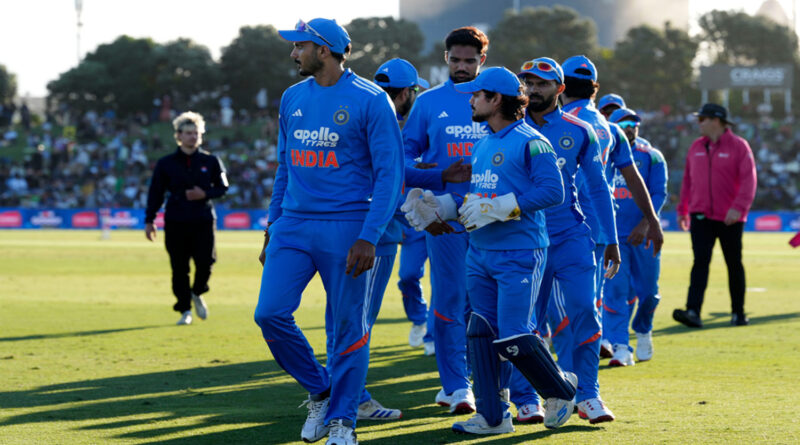
India face stern batting test against New Zealand pacers in series-deciding fifth ODI
Mount Maunganui, November 14
India will look to put their batting collapse behind them and secure a series victory when they take on New Zealand in the fifth and final ODI at Mount Maunganui on Sunday, with their top-order batters facing a crucial examination against the hosts’ formidable pace attack.
India lead the five-match series 2-1 after winning the first two ODIs, while the third match was washed out due to rain. However, the visitors suffered a crushing 244-run defeat in the fourth ODI on Friday, being bowled out for just 89 while chasing a target of 334.
The result exposed India’s struggles against the moving ball and raised questions about their ability to negotiate pace-friendly conditions, particularly with the 2027 ODI World Cup in South Africa on the horizon.
For India, the final ODI presents an opportunity to finish the tour with a series victory, but their experienced batting trio of Rohit Sharma, Virat Kohli and stand-in captain Shreyas Iyer will be under pressure to deliver after all three were dismissed for ducks in the previous match.
New Zealand pacer Matt Henry dismantled India’s top order in the fourth ODI, removing Rohit, Kohli and Iyer in the opening over to leave the visitors reeling at 0/3. Kyle Jamieson then dismissed Ruturaj Gaikwad for five, reducing India to 9/4 inside six overs.
Henry eventually returned with outstanding figures of 6/27, while Matthew Fisher claimed three wickets as India were bundled out in just 26.4 overs.
Head coach Gautam Gambhir expressed concern over the manner in which the batting unit surrendered, pointing out that the conditions in New Zealand could resemble those India might encounter at the next World Cup.
“These are conditions which are going to be closest to what we might get during the World Cup. The bigger concern is not the runs. It’s how quickly we got bundled out, around 26 or 27 overs. That is something which is always a concern,” Gambhir said after the fourth ODI.
The Indian batting unit will need a collective response rather than relying on individual contributions. Rohit and Kohli, who are primarily active in the ODI format, will be particularly keen to finish the New Zealand tour on a positive note. Both experienced batters have struggled to make a significant impact in the series and will be expected to provide stability at the top.
Iyer, meanwhile, will be looking to put his disappointing captaincy debut behind him. The stand-in skipper was dismissed by a sharp incoming delivery in the previous match and will have to make better decisions against the movement generated by the New Zealand seamers.
The team management will also be keen to see a stronger contribution from the middle order. Ishan Kishan, who batted at number five in the fourth ODI, managed 27 off 53 deliveries, while Axar Patel scored 21. Their efforts, however, were not enough to prevent the collapse.
Ruturaj Gaikwad, who opened alongside Rohit in the previous game, managed only five runs. It remains to be seen whether the team management retains the combination or makes adjustments to the batting order for the series finale.
Another player who will be eager to make an impact is Kuldeep Yadav. The left-arm wrist spinner, who has had limited opportunities during the tour after being released from the Test squad, struggled in the fourth ODI as Will Young attacked him during New Zealand’s innings.
Kuldeep will hope for another opportunity to demonstrate his value, particularly if the Indian team management opts to strengthen its spin options for the final encounter.
New Zealand, meanwhile, will enter the contest with renewed confidence after their emphatic performance in the fourth ODI. Having reduced India to 9/4, the hosts demonstrated how effective their pace attack can be under favourable conditions.
Their batting unit also showed considerable depth, with Will Young leading the way with a magnificent 125 off 108 deliveries. Tim Seifert contributed 58 off 48 balls, while Finn Allen added 41 as New Zealand posted 333 in 50 overs.
Young and Seifert gave the hosts an excellent start with an 85-run opening partnership, while Young later combined with Allen for another 90-run stand. The opening pair will once again be crucial as New Zealand look to put India’s bowling attack under pressure during the powerplay.
Seifert’s half-century was particularly significant as the wicketkeeper-batter made the most of his opportunity at the top of the order. Young, meanwhile, rediscovered his form with a commanding century and will be keen to carry that momentum into the final match.
New Zealand captain Mitchell Santner will also be encouraged by the performance of his fast bowlers, particularly Henry, who has emerged as a major threat throughout the series.
An interesting aspect of the contest has been New Zealand’s overwhelming reliance on pace. According to CricViz statistics, fast bowlers have delivered 97.5 per cent of the balls bowled by New Zealand in the series, with spinners accounting for just 2.5 per cent.
It is the lowest proportion of spin bowling by New Zealand in an ODI series since the 1995-96 season, when they toured India and did not bowl a single delivery of spin in matches with available ball-by-ball data.
The statistics underline the hosts’ confidence in their seamers and the conditions on offer. Henry, Jamieson and Fisher have consistently troubled the Indian batters, and they are likely to remain central to New Zealand’s plans for the final ODI.
New Zealand will also be looking to maintain their impressive record on home soil. The Black Caps have not lost a bilateral series at home in seven years and will be determined to preserve that record by drawing the contest 2-2.
India have a 14-member squad available for the final ODI, with Shreyas Iyer leading the side and Ishan Kishan serving as vice-captain. The squad also includes Rohit, Kohli, Tilak Varma, Axar, Naman Dhir, Gaikwad, Kuldeep and Mohammed Siraj.
New Zealand have named a 14-member squad led by Santner, with Finn Allen, Seifert, Young, Michael Bracewell and Jamieson among the key players.
The hosts could also consider handing uncapped pacer Brett Randell an opportunity, although their existing fast-bowling combination delivered a comprehensive performance in the previous match.
For India, the challenge will be to find a way to counter New Zealand’s seam movement without compromising their natural attacking approach. The visitors have shown glimpses of their batting ability in the opening two matches but have struggled to maintain consistency across the series.
The first ODI saw India lose four wickets for just 22 runs after reaching 114/1, while they slipped to 111/7 in the second match before eventually securing a narrow victory through the DLS method.
The fourth ODI exposed those vulnerabilities more severely, making the final encounter an important test of the team’s ability to respond after a heavy defeat.
India will be keen to avoid allowing one poor performance to define their tour, while New Zealand have the opportunity to level the series and extend their impressive home record.
With the series still in India’s hands, the visitors will need their senior batters to step up against a pace attack that has dominated the previous encounter. A much-improved performance with the bat could help India seal the series, while another collapse would give the hosts a chance to finish the contest on level terms. (ANI)