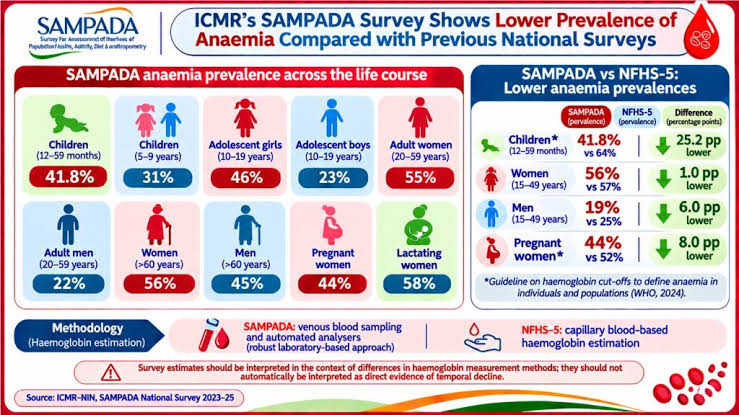
ICMR’s survey finds lower anaemia prevalence across age groups compared to previous surveys
New Delhi, November 23
The Indian Council of Medical Research ( ICMR ) has released key findings from the Survey for Assessment of Markers of Population Health, Activity, Diet and Anthropometry (SAMPADA) 2023-2025, providing comprehensive national evidence on anaemia and micronutrient deficiencies across the life course.
ICMR said, the SAMPADA findings shows an encouraging shift with overall lower prevalence of anaemia compared to previous surveys. The difference is particularly large in case of children aged 12-59 months who had 42 per cent anaemia prevalence. Adolescent girls aged 10-19 years had anaemia prevalence of 46 per cent, adolescent boys aged 10-19 years and men aged 20-59 years had 22 to 23 per cent anaemia prevalence whereas women of reproductive age had 56 per cent prevalence.
ICMR said, SAMPADA represents one of the largest and most comprehensive nutrition surveys undertaken globally. The survey covered more than two lakh individuals from over 81 thousand households across 183 districts in 35 States and Union Territories. More than 1.7 lakh blood samples were analysed for haemoglobin estimation across different age, sex and physiological groups.
ICMR informed that a major strength of SAMPADA is the use of gold standard method of venous blood sampling and automated analysers for haemoglobin estimation, providing greater accuracy and reproducibility. In a sub-sample, the survey also assessed iron status, folate, vitamin B12, together with inflammatory biomarkers C-reactive protein (CRP) and alpha-1-acid glycoprotein (AGP) to obtain national level prevalence estimates.
The survey also provides nationally representative estimates among older adults, extending the assessment of anaemia to an age group for which national-level evidence has been limited. The findings also highlight important differences by age, sex, physiological status and location, reinforcing the need for population-specific approaches rather than a single strategy for all groups.