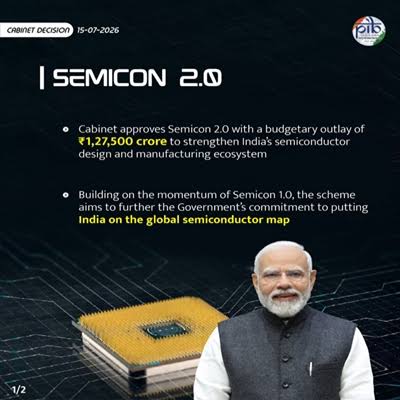
Govt approves Semicon 2.0 to strengthen semiconductor ecosystem
New Delhi, July 15
The Union Cabinet has approved the Semicon 2.0 programme with a budgetary outlay of 1 lakh 27 thousand 500 crore rupees for the development of India’s semiconductor design and manufacturing ecosystem.
Addressing media, Information and Broadcasting Minister Ashwini Vaishnaw said that building on the momentum of Semicon 1.0, the scheme aims to further the government’s commitment to putting India on the global semiconductor map. He said that the scheme will support economic growth, strengthen supply chain resilience, and establish technological leadership in critical sectors. The minister said that Semicon 2.0 seeks to holistically build the semiconductor ecosystem through six pillars- Design, Machines and materials, Setting up more fabs, Further strengthening the ATMP-OSAT industry and Research and Development.
Mr Vaishnaw said that in Semicon 1.0 programme, the focus was on starting and establishing the industry and Under Semicon 2.0, the chips required for all our strategic needs will be designed in India, and by the end of this semiconductor programme, the country will become self-reliant in chip design.
Mr Vaishnaw also stated that, given the growing global interest in India’s semiconductor programme, every major industry leader wants to establish a presence in the country. He added that India has already forged partnerships with the US, Japan, the EU, the Netherlands, Singapore, and Germany. He informed that under Semicon 2.0, investment worth four lakh crore rupees is expected.
The Union Cabinet also approved the Mobile Phone Manufacturing Scheme ((MPMS) with a budgetary outlay of 62 thousand 500 crore rupees. Mr Vaishnaw said that the scheme will be implemented for the next 5 years. He said that the scheme will provide incentive support of 2.25 percent to 5 percent on eligible sales for manufacturing mobile phones in the country. The minister said that an additional incentive of up to 1.5 percent is linked to domestic sourcing of key components and sub-assemblies.
He said the scheme is expected to generate cumulative mobile phone production of approximately 39 lakh crore rupees during its tenure, while the cumulative exports are expected to increase from approximately 7.5 lakh crore rupees to 15 lakh crore rupees. Mr Vaishnaw informed that the scheme is also expected to create around 60 thousand direct jobs.
The Union Cabinet also approved the National Investment Policy for Urea-2026 for Atmanirbhar Bharat (NIPU-2026). Mr Vaishnaw said that the Policy seeks to encourage new investments in urea sector for setting up gas-based urea manufacturing units in the country, helping achieve the goal of self-sufficiency.
The new policy includes key changes such as separation of fixed and variable costs for greater transparency and the introduction of a Return on Equity (RoE) band with a floor at 12 percent and a ceiling at 16 percent. The changes are estimated to result in savings of over 250 crore rupees per plant established under NIPU-2026 compared to NIP-2012.
The Union Cabinet approved two multitracking projects covering four districts across Odisha and Jharkhand, expanding the Indian Railways network by about 145 kms. The Project includes Paradeep-Haridaspur Doubling in Odisha and Rajkharsawan-Dangoaposi 4th Line in Jharkhand. With total estimated cost of approximately 3 thousand 907 crore rupees, the projects are expected to be completed by 2030-31.