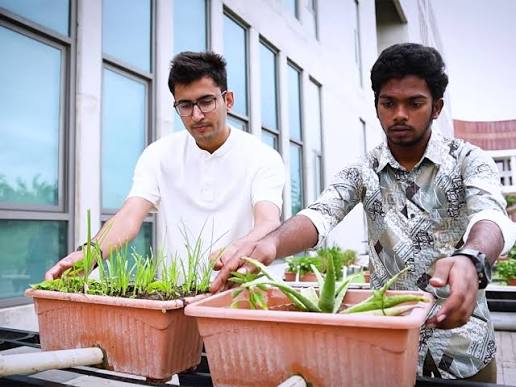
IIT Hyderabad students turn sunlight and fish waste into sustainable solutions
Hyderabad, November 10
From cooking meals using sunlight to growing plants through a system that recycles water with the help of fish, students at the Indian Institute of Technology (IIT) Hyderabad are exploring innovative, sustainable solutions to everyday challenges.
The two projects focus on making better use of available resources, addressing practical needs and demonstrating how affordable technology can contribute to a more sustainable future.
One of the innovations is a portable solar cooker designed especially for daily-wage workers who often struggle to find the time and facilities to prepare meals at their workplaces.
Developed by IIT Hyderabad students, the cooker uses solar energy instead of conventional fuels such as LPG, electricity or firewood. Its portable design allows workers to carry it along and prepare meals, including rice, wherever sunlight is available.
Explaining the idea behind the innovation, Chandrakant, an IIT Hyderabad student, said the team developed the cooker keeping in mind the difficulties faced by daily-wage workers.
“This solar cooker is a simple and useful product, particularly for daily-wage workers. During long working hours, cooking becomes difficult because they often lack both the time and the facilities or space to prepare meals. Keeping this need in mind, we have developed a low-cost and portable solar cooker that they can easily carry and use at their workplace,” he said.
The portable and waterproof cooker has been designed using readily available, low-cost materials. It uses reflective Mylar sheets to concentrate sunlight onto an aluminium tiffin box placed at the centre, generating heat for cooking.
Mayank, another student involved in the project, said affordability and ease of use were central to the design.
“We have used low-cost materials so that ordinary people can afford the product. It is made using Mylar sheets, a 3D-printed base and an aluminium tiffin box. The main objective of this solar cooker is to enable daily-wage workers to prepare their meals at their workplace,” he said.
Moving beyond solar-powered cooking, the students are also exploring sustainable farming through an aquaponics system, which combines fish farming with soilless plant cultivation.
The system operates through a closed-loop mechanism in which water from fish tanks is circulated through plant-growing units. Fish waste provides nutrients for the plants, while beneficial bacteria convert the waste into forms that plants can absorb. As the plants take up these nutrients, the water is naturally filtered before being returned to the fish tank.
Explaining the concept, Kashish, a PhD scholar at IIT Hyderabad, said, “We have undertaken a project on aquaponics, which we call the Sustainable Farming Project. Fish are raised in a tank, and the waste they produce acts as a source of nutrients for plants. The plants absorb these nutrients from the water, helping to clean it naturally. The filtered water is then circulated back into the fish tank. In this way, the entire system works as a closed loop, with water continuously being recycled.”
The technology offers an alternative approach to cultivation, particularly in areas where conventional soil-based farming is difficult. By combining fish farming and plant cultivation, the system aims to make efficient use of water and nutrients while reducing dependence on fertile soil.
Explaining the science behind the process, IIT Hyderabad student Pradeep Kumar said beneficial bacterial growth in the plant-growing medium plays an important role in converting fish waste into nutrients that plants can absorb.
“When fish are fed, they produce waste that enters the water. This water is then circulated through the plant-growing units, where stones provide a surface for beneficial bacteria to grow. These bacteria convert the waste produced by the fish into nutrients that plants can absorb,” he explained.
While one innovation harnesses solar energy to address the everyday cooking needs of workers, the other brings together fish and plants to explore more efficient and sustainable farming practices.
Together, the projects highlight how young innovators at IIT Hyderabad are applying science and engineering to develop practical solutions that make better use of limited resources and address real-world challenges. (ANI)