India and Australia sign landmark deals on uranium supply and dedicated Critical Minerals Corridor
Melbourne,July 09
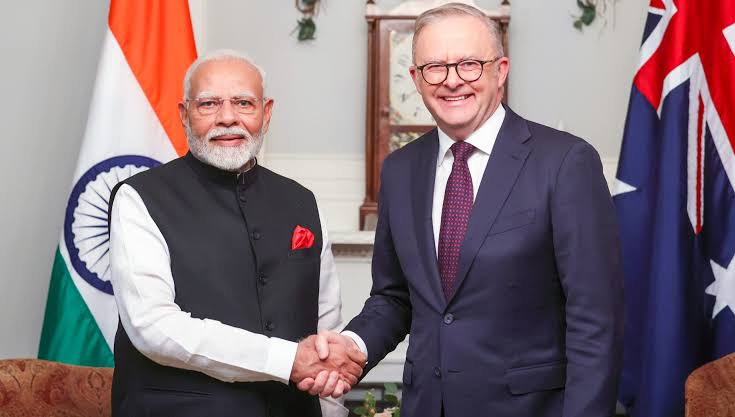
Prime Minister Narendra Modi and his Australian counterpart, Anthony Albanese, participated in the 3rd Australia-India Annual Leaders’ Summit in Melbourne today, during which they held delegation-level talks aimed at strengthening bilateral ties. Both Prime Ministers delivered joint Press Statements at Government House, Victoria, following the conclusion of the Summit.
The two leaders hailed a transformative “step change” in the bilateral relationship, locking in comprehensive frameworks for regional stability, energy security, and technological innovation. To secure peace and stability across the Indo-Pacific, the leaders signed a landmark Joint Declaration on Defence and Security Cooperation, institutionalized an Annual Defence Ministers’ Dialogue, and launched a unified Maritime Security Collaboration Roadmap. Describing India and Australia as “vibrant democracies and important ocean powers”, Prime Minister Modi said that the Indo-Pacific is not just a meeting point of two oceans but showcases the shared aspirations of like-minded democracies like India and Australia.
Addressing the media, he highlighted that the relationship has entered an expansive era anchored in deep mutual trust. A major highlight of the summit was the significant momentum given to economic and trade integration. Building on the success of the 2022 Economic Cooperation and Trade Agreement (ECTA), the two nations have committed to fast-tracking a balanced, ambitious, and mutually beneficial Comprehensive Economic Cooperation Agreement (CECA), alongside a Bilateral Investment Treaty.
In a massive breakthrough for energy security, a critical agreement was signed to pave the way for long-term Australian uranium supply to India, injecting major strength into India’s clean energy objectives. This complements the thriving Renewable Energy Partnership, under which both nations have jointly established a Rooftop Solar Training Academy in Gujarat to empower women and youth. Strategic technology and resource security also reached new heights with the operationalisation of the ‘Australia-India Partnership on Cyber, Critical Technologies and Supply Chains’ (AI-PACTS) and a dedicated Critical Minerals Corridor.
In a massive economic breakthrough, the signing of the final Administrative Arrangement under the Nuclear Cooperation Agreement will unlock long-term Australian uranium exports to power India’s clean energy transition. Educational integration also reached unprecedented heights, with new university branch campuses expanding into Bengaluru and Gurugram. Albanese emphasised that the ultimate heart of this future-ready partnership remains the vibrant Indian diaspora bridging both nations.
This landmark summit signals a historic “step change” as New Delhi and Canberra systematically lock in a future-proof architecture for the Indo-Pacific. By transitioning from traditional trade to critical high-tech defence corridors, fast-tracking the ambitious CECA, and unleashing long-term uranium exports under a historic nuclear arrangement, both nations have elevated mutual trust to an unprecedented scale.
While Prime Minister Albanese correctly identified our one-million-strong diaspora as the ultimate heartbeat of this alliance, Prime Minister Modi flawlessly captured our momentum, proving that our shared decisions are swift as a T-20, our focus is razor-sharp like a One-Day, and this strategic partnership is as deep and enduring as a classic Test match.